
Understanding Evenity (Romosozumab-aqq): A Breakthrough in Osteoporosis Therapy
Evenity (romosozumab-aqq) represents a significant paradigm shift in the treatment of osteoporosis. Unlike traditional antiresorptive agents that primarily focus on slowing down bone breakdown, Evenity is a sclerostin inhibitor that possesses a dual-action effect: it increases bone formation while simultaneously decreasing bone resorption. This guide serves as an authoritative resource for healthcare professionals and patients seeking to understand the pharmacodynamics, clinical application, and safety profile of this potent bone-building medication.
Mechanism of Action: The Sclerostin Pathway
At the molecular level, Evenity functions as a monoclonal antibody that binds to and inhibits sclerostin. Sclerostin is a protein produced by osteocytes that acts as a negative regulator of bone formation by inhibiting the Wnt signaling pathway.
The Dual-Action Process:
- Bone Formation (Anabolic): By inhibiting sclerostin, Evenity releases the "brake" on the Wnt signaling pathway. This stimulates osteoblast activity, leading to increased bone formation on both trabecular and cortical bone surfaces.
- Bone Resorption (Antiresorptive): Simultaneously, the reduction in sclerostin activity leads to a decrease in the expression of RANK ligand, which in turn reduces osteoclast-mediated bone resorption.
This dual effect is unique, allowing for rapid increases in bone mineral density (BMD) that often exceed the clinical performance of bisphosphonates or denosumab.
Clinical Indications and Usage
Evenity is FDA-approved for the treatment of osteoporosis in postmenopausal women at high risk for fracture. High risk is defined as a history of osteoporotic fracture or multiple risk factors for fracture, or patients who have failed or are intolerant to other available osteoporosis therapies.
Clinical Considerations:
- Treatment Duration: Evenity is administered as a monthly injection for a limited course of 12 doses.
- Transitioning Therapy: Following the 12-month course of Evenity, patients should transition to an antiresorptive agent (such as bisphosphonates) to maintain the gains in bone mineral density.
Dosage and Administration Guidelines
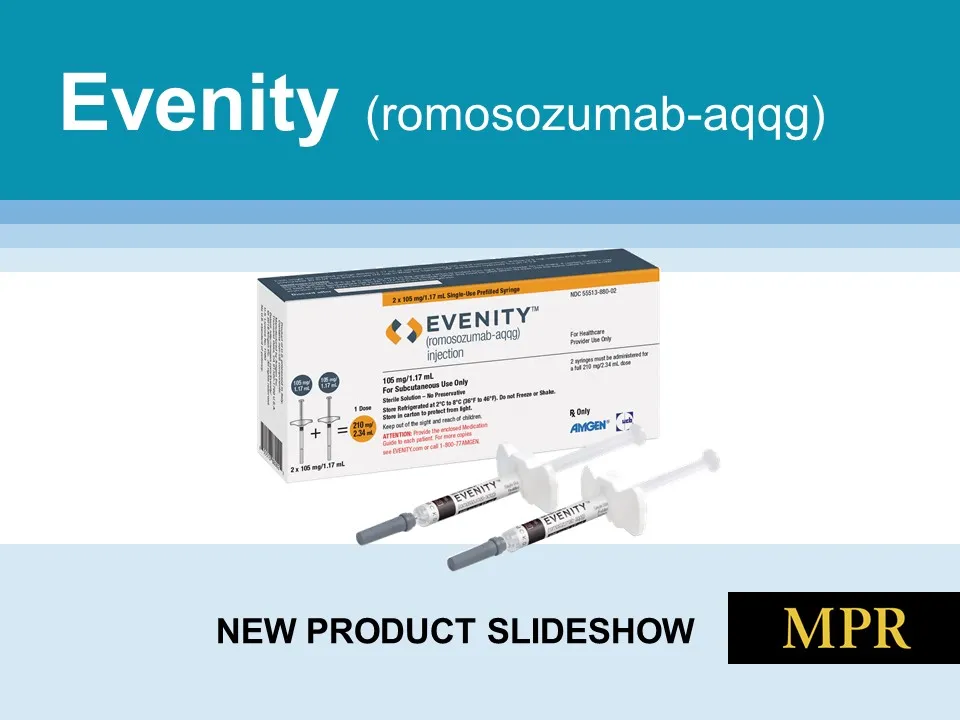
Evenity is supplied as a sterile, preservative-free solution in a single-use prefilled syringe.
Standard Dosage Protocol:
- Recommended Dose: 210 mg administered as two separate subcutaneous injections of 105 mg each.
- Administration Site: Injections should be given consecutively, one after the other, in the abdomen, thigh, or upper arm.
- Frequency: Once every month.
| Parameter | Specification |
|---|---|
| Dosage Strength | 105 mg/1.17 mL per syringe |
| Total Monthly Dose | 210 mg (2 syringes) |
| Route of Administration | Subcutaneous |
| Duration of Therapy | 12 Monthly Doses |
Pharmacokinetics
Understanding the metabolic path of romosozumab is essential for clinical management:
* Absorption: Following subcutaneous administration, the mean bioavailability is approximately 81%. Peak serum concentrations occur within 2 to 5 days.
* Distribution: The volume of distribution is approximately 3.92 L.
* Metabolism: Romosozumab is degraded into small peptides and amino acids via catabolic pathways.
* Elimination: The elimination half-life is approximately 12.8 days.
Contraindications and Safety Warnings
The use of Evenity is strictly contraindicated in certain patient populations to prevent adverse clinical outcomes.
Primary Contraindications:
- Hypocalcemia: Pre-existing hypocalcemia must be corrected before initiating treatment.
- Hypersensitivity: Known hypersensitivity to romosozumab or any of its components.
Serious Cardiovascular Warnings (Boxed Warning):
Evenity may increase the risk of myocardial infarction, stroke, and cardiovascular death. It should not be initiated in patients who have had a myocardial infarction or stroke within the preceding year. Healthcare providers must weigh the benefits against the risks in patients with established cardiovascular disease.
Drug Interactions and Pregnancy/Lactation
Drug-Drug Interactions:
There are no formal drug-drug interaction studies for Evenity. However, clinicians should exercise caution when co-administering with other medications that affect bone metabolism, such as systemic corticosteroids or other bone-modifying agents.
Pregnancy and Lactation:
- Pregnancy: Evenity is not indicated for use in women who are pregnant. Animal studies have shown potential reproductive toxicity.
- Lactation: It is unknown whether romosozumab is excreted in human milk. Due to the potential for serious adverse reactions in the infant, breastfeeding is not recommended during therapy.
Overdose Management
There is limited clinical experience with overdose. In the event of an accidental overdose, the patient should be monitored for signs of hypocalcemia or other adverse reactions. Routine supportive care should be implemented, and the patient should be monitored for any cardiovascular symptoms given the drug's safety profile.
Frequently Asked Questions (FAQ)
1. How is Evenity different from bisphosphonates?
Bisphosphonates are primarily antiresorptive, meaning they prevent bone loss. Evenity is an anabolic agent that actively builds bone while also slowing resorption.
2. Is Evenity safe for men with osteoporosis?
While initially approved for postmenopausal women, clinical studies have explored its efficacy in men, though users should consult their physician regarding current FDA-label indications and off-label usage.
3. Can I take Evenity for more than 12 months?
No. The clinical safety and efficacy of Evenity have only been established for a 12-month treatment course. Using it for longer than this duration is not currently recommended.
4. What happens if I miss a dose?
If a dose is missed, it should be administered as soon as possible. Subsequent doses should then be scheduled monthly from the date of the last injection.
5. Does Evenity cause jaw problems?
Like other bone-modifying agents, there is a theoretical risk of osteonecrosis of the jaw (ONJ). Patients should undergo a dental examination prior to starting treatment.
6. Are there specific lab tests required before starting?
Yes, serum calcium levels should be checked to ensure they are within the normal range before each dose.
7. Does insurance typically cover Evenity?
Most insurance plans cover Evenity for patients who meet the high-risk criteria, but prior authorization is usually required.
8. What should I do if I experience chest pain while on Evenity?
Seek immediate emergency medical attention. Because of the risk of myocardial infarction and stroke, any cardiovascular symptoms must be evaluated urgently.
9. Can I take calcium and Vitamin D supplements with Evenity?
Yes, it is highly recommended that patients maintain adequate intake of calcium and Vitamin D to support the bone-building process.
10. What is the "rebound effect" after stopping Evenity?
After stopping any bone-building agent, bone density can decrease. This is why physicians mandate transitioning to an antiresorptive agent (like alendronate or denosumab) immediately after the 12-month Evenity course.
Clinical Best Practices for Orthopedic Specialists
When prescribing Evenity, the orthopedic specialist must act as a coordinator of care. The following checklist is recommended for every patient starting therapy:
- Baseline Assessment: Perform a DXA scan to establish a baseline BMD.
- Dental Clearance: Ensure the patient has had a recent dental evaluation to mitigate ONJ risk.
- Cardiovascular Screening: Document a history of MI or stroke within the last 12 months.
- Patient Education: Ensure the patient understands the 12-month limit and the necessity of follow-up antiresorptive therapy.
- Monitoring: Schedule monthly follow-ups to administer the injection and monitor for adverse events.
Conclusion
Evenity (romosozumab-aqq) stands as a powerful tool in the orthopedic surgeon's armamentarium against osteoporosis. By stimulating bone formation and inhibiting resorption, it offers a distinct advantage for high-risk patients. However, its use requires a careful balance of risk assessment—particularly regarding cardiovascular health—and a disciplined approach to follow-up care. Through informed prescribing and patient education, Evenity can significantly reduce fracture risk and improve quality of life for patients struggling with skeletal fragility.
Disclaimer: This guide is for educational purposes only and does not constitute medical advice. Always consult with a licensed healthcare provider or the official prescribing information provided by the manufacturer before initiating, modifying, or discontinuing any medication.