
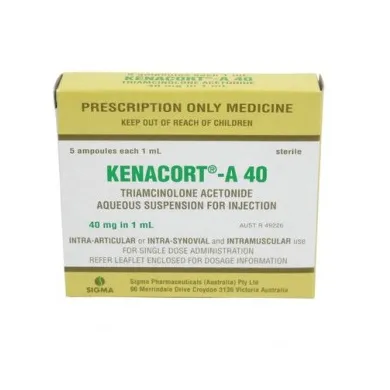

Comprehensive Guide to Kenacort (Triamcinolone Acetonide)
Kenacort, known generically as Triamcinolone Acetonide, is a potent synthetic corticosteroid used extensively in orthopedic, dermatological, and systemic medicine. As a glucocorticoid, it is primarily employed for its profound anti-inflammatory and immunosuppressive properties. In the orthopedic field, it is a gold-standard treatment for managing joint inflammation, bursitis, and various connective tissue disorders.
This guide provides an exhaustive clinical overview of Kenacort, designed for healthcare professionals and patients seeking a deep understanding of its pharmacological profile, safety standards, and therapeutic application.
1. Mechanism of Action: The Pharmacological Foundation
Kenacort operates by binding to high-affinity cytoplasmic glucocorticoid receptors. Once the drug-receptor complex is formed, it translocates into the cell nucleus, where it modulates the transcription of specific genes.
Key Physiological Effects:
- Inhibition of Phospholipase A2: By inducing the synthesis of lipocortins (annexins), Kenacort inhibits the production of arachidonic acid, thereby blocking the synthesis of prostaglandins and leukotrienes—the primary mediators of inflammation and pain.
- Leukocyte Suppression: It reduces the migration of polymorphonuclear leukocytes and reverses increased capillary permeability, effectively curbing acute inflammatory responses.
- Immunosuppression: It suppresses the immune system by reducing the volume and activity of the lymphatic system, decreasing the concentration of immunoglobulins and complement components.
2. Pharmacokinetics: Absorption, Distribution, and Metabolism
Understanding the pharmacokinetic profile of Triamcinolone Acetonide is essential for predicting the onset and duration of its clinical effects.
| Parameter | Description |
|---|---|
| Route of Administration | Intra-articular, Intralesional, Intramuscular, or Topical |
| Onset of Action | Varies by route; typically 24–48 hours for systemic effect |
| Protein Binding | Approx. 60-70% bound to plasma proteins (transcortin/albumin) |
| Metabolism | Hepatic (primarily via CYP3A4 enzymes) |
| Half-life | Biological half-life is 12–36 hours (plasma half-life is shorter) |
| Excretion | Primarily renal (metabolites) |
3. Clinical Indications and Therapeutic Usage
Kenacort is versatile in its application. In orthopedics, it is frequently utilized for localized, sustained anti-inflammatory action.
Orthopedic and Rheumatological Indications
- Osteoarthritis: Intra-articular injection to reduce synovial inflammation and pain.
- Bursitis/Tendinitis: Treatment of acute subdeltoid or subacromial bursitis.
- Rheumatoid Arthritis: Management of acute flares in specific joints.
- Epicondylitis: Injection for lateral or medial epicondylitis (Tennis/Golfer’s elbow).
Dermatological and Systemic Indications
- Keloids and Hypertrophic Scars: Intralesional injection to reduce collagen synthesis.
- Psoriasis and Eczema: Topical applications for chronic plaque management.
- Allergic States: Management of severe seasonal or perennial allergic rhinitis.
4. Dosage Guidelines: A Clinical Perspective
Dosage must be individualized based on the disease severity, the joint size, and the patient’s clinical response.
Intra-articular and Intrasynovial Guidelines
- Large Joints (Knee, Hip, Shoulder): 5 mg to 15 mg.
- Small Joints (Fingers, Toes): 2.5 mg to 5 mg.
- Bursae: 2.5 mg to 15 mg depending on the site.
Note: Repeated injections should be spaced at least 3–4 weeks apart to prevent joint degradation and systemic side effects.
5. Contraindications and Safety Warnings
Kenacort is a powerful medication that requires strict adherence to safety protocols.
Absolute Contraindications
- Systemic Fungal Infections: Corticosteroids can exacerbate these conditions.
- Hypersensitivity: Known allergy to Triamcinolone or any component of the formulation.
- Active Infection at Injection Site: Injecting into an infected joint can lead to septic arthritis.
Relative Contraindications / Precautions
- Diabetes Mellitus: Steroids increase blood glucose levels; monitoring is essential.
- Hypertension: Can lead to sodium and water retention.
- Peptic Ulcer Disease: Potential for gastrointestinal irritation and bleeding.
- Osteoporosis: Long-term use can exacerbate bone density loss.
6. Drug Interactions
Pharmacists and physicians must be vigilant regarding the following interactions:
- Non-Steroidal Anti-Inflammatory Drugs (NSAIDs): Increased risk of gastrointestinal ulceration.
- Anticoagulants: Corticosteroids may alter the response to warfarin; frequent INR monitoring is required.
- Diuretics: Potential for hypokalemia (potassium depletion) when used concurrently with potassium-depleting diuretics.
- Vaccines: Immunosuppressive doses may reduce the efficacy of live virus vaccines and increase the risk of infection.
7. Pregnancy and Lactation
- Pregnancy: Kenacort is classified under Pregnancy Category C. Studies in animals show evidence of teratogenicity. It should be used during pregnancy only if the potential benefit justifies the potential risk to the fetus.
- Lactation: Corticosteroids are excreted in breast milk. While systemic effects in the infant are unlikely with low doses, caution is advised. Consult an obstetrician before use.
8. Overdose Management
Acute overdose of Kenacort is unlikely to result in immediate life-threatening symptoms unless it is a massive systemic dose. However, chronic over-exposure can lead to Cushingoid features (moon face, buffalo hump, weight gain, thinning skin).
- Management: There is no specific antidote. Treatment is supportive and symptomatic. If systemic toxicity is suspected, the dosage should be tapered gradually rather than stopped abruptly to avoid acute adrenal insufficiency.
9. Frequently Asked Questions (FAQ)
1. How long does it take for Kenacort to work?
Most patients report symptomatic relief within 24 to 48 hours following an injection, though the peak effect may take up to a week.
2. Can I receive multiple Kenacort injections in the same joint?
Yes, but they should generally be spaced 3–4 weeks apart. Excessive injections can weaken the cartilage and surrounding tendons.
3. What is the most common side effect?
Localized pain or "flare" at the injection site is common, occurring shortly after the injection. This usually subsides within 48 hours.
4. Will Kenacort raise my blood sugar?
Yes. Patients with diabetes should monitor their blood glucose levels closely for 7–10 days post-injection, as Kenacort can induce temporary hyperglycemia.
5. Can Kenacort cause weight gain?
Local injections are less likely to cause systemic weight gain compared to oral steroids. However, systemic absorption can occur, and long-term use may lead to fluid retention.
6. Is it safe to drive after an injection?
Generally, yes. However, if the injection site is painful or if you feel lightheaded, it is recommended to rest for a few hours.
7. Does Kenacort weaken the bone?
Long-term, high-dose systemic use is associated with osteoporosis. Localized injections, when performed correctly, have a minimal impact on overall bone density.
8. What should I do if I miss a dose?
If you are on an oral regimen, take the missed dose as soon as you remember. If it is close to your next dose, skip the missed one. Do not double up.
9. Can I drink alcohol while on Kenacort?
Alcohol may increase the risk of gastrointestinal side effects and may interfere with the body's ability to heal. It is best to avoid or limit alcohol consumption.
10. When should I contact my doctor?
Contact your physician immediately if you experience severe pain, redness, fever, or swelling at the injection site, as these could be signs of a post-injection infection.
Disclaimer: This guide is intended for informational purposes only and does not constitute medical advice. Always consult with a qualified orthopedic specialist or medical professional regarding your specific health condition and treatment plan.