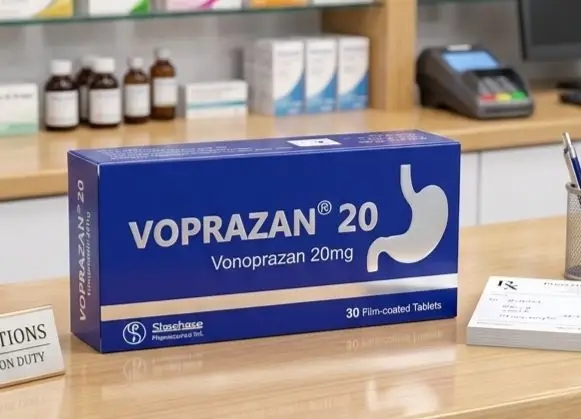
Comprehensive Clinical Guide: Voprazan (Vonoprazan Fumarate)
1. Introduction and Overview
Voprazan, known generically as Vonoprazan Fumarate, represents a paradigm shift in the management of acid-related gastrointestinal disorders. Unlike traditional Proton Pump Inhibitors (PPIs) such as omeprazole or esomeprazole, which are benzimidazole derivatives, Voprazan is classified as a Potassium-Competitive Acid Blocker (P-CAB).
Developed to overcome the pharmacokinetic limitations of traditional PPIs—namely their slow onset of action, susceptibility to CYP2C19 genetic polymorphism, and instability in acidic environments—Voprazan provides rapid, potent, and sustained acid suppression. This guide serves as a technical resource for clinicians, pharmacists, and medical professionals regarding the pharmacology, clinical application, and safety profile of Voprazan.
2. Deep-Dive: Mechanism of Action and Pharmacokinetics
2.1 Mechanism of Action (The P-CAB Advantage)
The gastric H+/K+-ATPase (the proton pump) is the final common pathway for acid secretion in the parietal cells of the stomach.
- PPIs vs. P-CABS: Traditional PPIs require activation in an acidic environment and bind covalently to the proton pump, a process that is time-dependent and requires the pump to be actively secreting acid.
- Voprazan’s Unique Binding: Voprazan acts as a reversible, potassium-competitive inhibitor. It binds to the H+/K+-ATPase at the potassium-binding site.
- Key Advantage: Because it does not require acid activation and does not require the pump to be in the active secretory state, Voprazan inhibits both active and resting pumps. This results in a faster onset (often within the first dose) and a more profound suppression of gastric acid.
2.2 Pharmacokinetics
| Parameter | Description |
|---|---|
| Absorption | Rapidly absorbed; peak plasma concentration (Tmax) is reached in approximately 1.5 to 2 hours. |
| Bioavailability | High oral bioavailability; food intake does not significantly affect absorption. |
| Metabolism | Primarily metabolized by CYP3A4, with minor contributions from CYP2B6, CYP2C19, and CYP2D6. |
| Half-life (t½) | Approximately 7 to 9 hours, allowing for once-daily dosing. |
| Excretion | Primarily renal (67%) and fecal (31%). |
3. Clinical Indications and Usage
Voprazan is indicated for a spectrum of gastrointestinal conditions where suppression of gastric acid is therapeutic.
3.1 Primary Indications
- Erosive Esophagitis (EE): Treatment and healing of all grades of erosive esophagitis.
- Gastroesophageal Reflux Disease (GERD): Maintenance of healing and relief of heartburn symptoms.
- Peptic Ulcer Disease: Treatment of gastric and duodenal ulcers.
- Helicobacter pylori Eradication: Used in triple-therapy regimens (with amoxicillin and clarithromycin or metronidazole) to eradicate H. pylori infection.
- NSAID-Induced Ulcer Prevention: Prophylaxis in patients requiring long-term non-steroidal anti-inflammatory drug (NSAID) therapy.
3.2 Dosage Guidelines
Note: Dosage may vary based on regional regulatory approval and specific clinical presentation.
| Indication | Recommended Dosage | Duration |
|---|---|---|
| Erosive Esophagitis | 20 mg once daily | 4–8 weeks |
| GERD Maintenance | 10 mg or 20 mg once daily | Long-term |
| Peptic Ulcer Disease | 20 mg once daily | 4–8 weeks |
| H. pylori Eradication | 20 mg twice daily | 7–14 days |
4. Risks, Side Effects, and Contraindications
4.1 Contraindications
- Hypersensitivity: Known allergy to Vonoprazan or any component of the formulation.
- Concurrent Use with Rilpivirine: Avoid co-administration with HIV medications containing rilpivirine, as Voprazan significantly decreases rilpivirine plasma concentrations.
4.2 Potential Side Effects
While generally well-tolerated, clinical studies have identified the following adverse events:
- Common (1–5%): Diarrhea, constipation, nausea, and abdominal distension.
- Less Common: Elevation in liver enzymes (ALT/AST), rash, or dizziness.
- Long-term Considerations: As with all acid-suppressive therapies, chronic use may lead to:
- Vitamin B12 Malabsorption: Due to reduced gastric acidity.
- Hypomagnesemia: Usually associated with prolonged use (>1 year).
- Increased Risk of Infections: Including Clostridioides difficile and community-acquired pneumonia, due to the alteration of gastric flora.
- Gastric Polyps: Specifically fundic gland polyps, typically benign.
5. Pregnancy, Lactation, and Special Populations
- Pregnancy: Data regarding Voprazan in pregnant women is limited. It should be used only if the potential benefit justifies the potential risk to the fetus.
- Lactation: It is unknown if Voprazan is excreted in human milk. Caution is advised when administering to breastfeeding women.
- Hepatic Impairment: Dose adjustment may be required for patients with severe hepatic impairment due to reduced metabolic clearance.
- Renal Impairment: No dose adjustment is typically required for mild to moderate renal impairment; however, monitor patients with severe renal failure.
6. Drug Interactions
Because Voprazan is primarily metabolized by the CYP3A4 enzyme, it is susceptible to interactions with inhibitors or inducers of this pathway.
- CYP3A4 Inhibitors (e.g., Clarithromycin, Ketoconazole): May increase plasma concentrations of Voprazan.
- CYP3A4 Inducers (e.g., Rifampin, St. John’s Wort): May decrease the efficacy of Voprazan.
- pH-Dependent Medications: Voprazan significantly increases gastric pH. Medications requiring an acidic environment for absorption (e.g., Atazanavir, Erlotinib, Iron salts) may have reduced clinical efficacy.
7. Massive FAQ Section
Q1: Is Voprazan better than Omeprazole?
Voprazan provides more rapid and consistent acid suppression compared to traditional PPIs like Omeprazole, particularly in patients who are extensive metabolizers of the CYP2C19 enzyme.
Q2: Can I take Voprazan with food?
Yes. Unlike many PPIs that must be taken 30–60 minutes before a meal, Voprazan’s pharmacokinetics are not significantly affected by food intake.
Q3: How long can I stay on Voprazan?
For maintenance of erosive esophagitis, long-term use is common. However, patients should be periodically evaluated by a gastroenterologist to determine the lowest effective dose.
Q4: Does Voprazan cause rebound acid hypersecretion?
While some acid rebound can occur upon cessation of any potent acid suppressant, Voprazan’s profile is generally comparable to or better than traditional PPIs in this regard. Tapering is recommended for long-term users.
Q5: What should I do if I miss a dose?
Take the missed dose as soon as you remember. If it is almost time for your next dose, skip the missed dose. Do not take two doses at once.
Q6: Does Voprazan interact with blood thinners?
Voprazan does not have the same inhibitory effect on CYP2C19 as some PPIs (like omeprazole), which may theoretically reduce the risk of interaction with Clopidogrel. However, always consult your physician regarding antiplatelet therapy.
Q7: Can Voprazan cause kidney problems?
While rare, interstitial nephritis has been reported with class-wide use of acid suppressants. Report any changes in urinary frequency or color to your doctor immediately.
Q8: Is it safe for children?
Safety and efficacy in pediatric populations have not been extensively established. It is generally reserved for adults unless specified by a pediatric specialist.
Q9: Does it cure H. pylori on its own?
No. Voprazan is used as a component of an H. pylori eradication regimen, which must include appropriate antibiotics to kill the bacteria.
Q10: How should Voprazan be stored?
Store at room temperature, away from moisture and heat. Keep in the original packaging to protect from light and humidity.
8. Overdose Management
There is limited clinical experience with Voprazan overdose. In the event of an overdose, treatment should be supportive and symptomatic. Given the protein-binding characteristics of the drug, hemodialysis is unlikely to be effective in removing the drug from the systemic circulation. Contact a poison control center or seek emergency medical attention if an intentional or accidental overdose is suspected.
Disclaimer: This guide is intended for informational and educational purposes for healthcare professionals. It does not replace professional medical judgment, diagnosis, or treatment. Always refer to the official Prescribing Information (PI) provided by the manufacturer in your specific region.