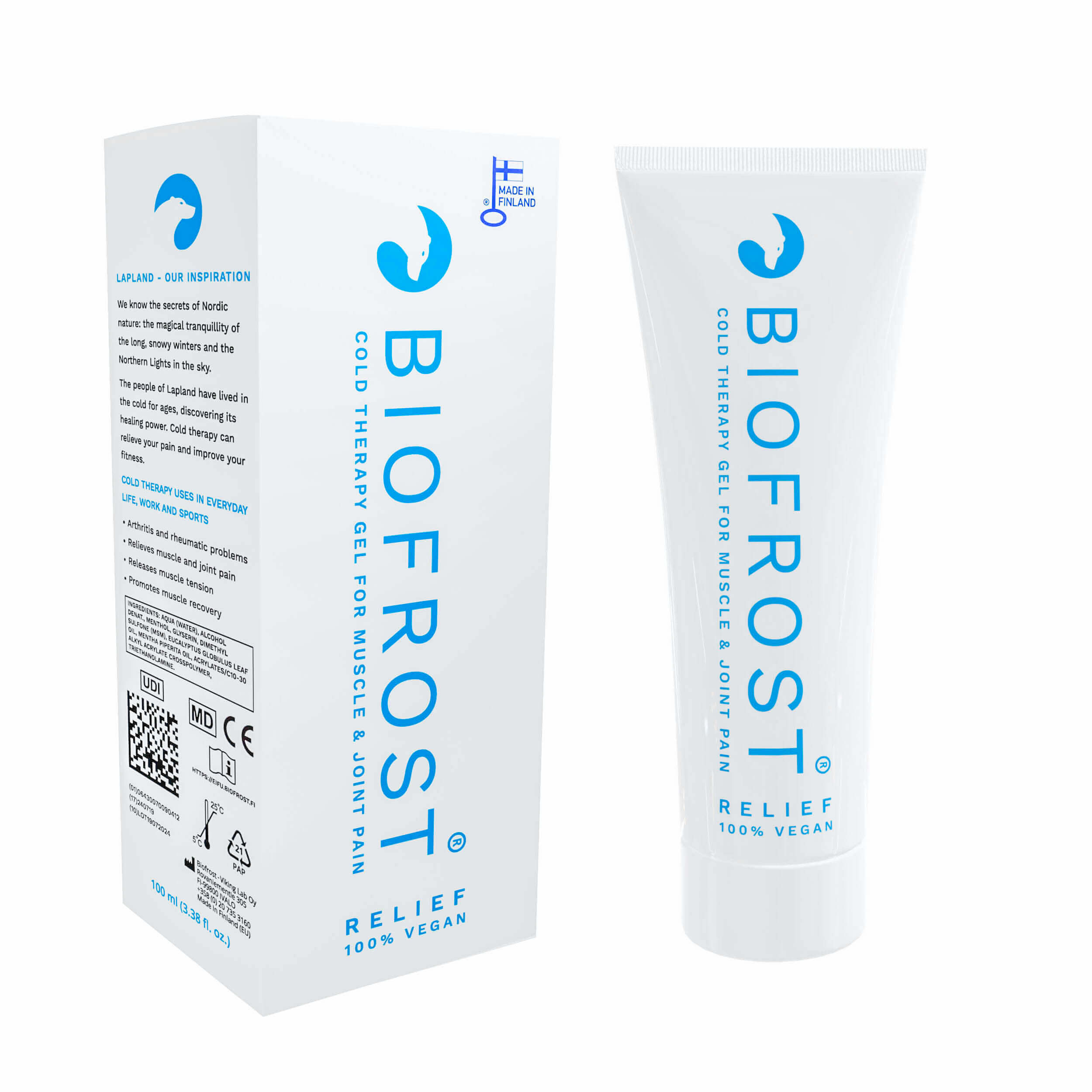
Comprehensive Guide to Biofrost Relief Cold Gel (100ml)
In the realm of orthopedic recovery and sports medicine, topical analgesics play a pivotal role in managing localized pain, inflammation, and musculoskeletal discomfort. Biofrost Relief Cold Gel 100ml stands as a sophisticated formulation designed to leverage the physiological benefits of cryotherapy in a convenient, non-invasive topical format. This guide provides an exhaustive clinical overview of the product, its pharmacological properties, and its appropriate application in a therapeutic setting.
1. Introduction and Overview
Biofrost Relief Cold Gel is a medical-grade topical analgesic designed to provide rapid cooling sensation to the skin and underlying tissues. Unlike systemic analgesics—which must undergo metabolic processing via the liver and kidneys—Biofrost utilizes a local application to target nociceptors (pain receptors) directly.
The 100ml tube is a standard clinical volume, allowing for multiple applications over several days of intensive rehabilitation or acute injury management. By inducing a localized "cold" effect, the gel distracts the nervous system from pain signals (the Gate Control Theory of Pain) and helps reduce metabolic activity in the localized area, potentially limiting secondary hypoxic injury in acute trauma.
2. Mechanism of Action and Pharmacokinetics
Mechanism of Action
The efficacy of Biofrost Relief Cold Gel is rooted in its ability to interact with the TRPM8 (Transient Receptor Potential Melastatin 8) ion channels. These channels are thermosensitive and are activated by cooling agents like menthol or specialized cryo-polymers.
- Nociceptive Inhibition: By stimulating TRPM8 receptors, the gel creates a cooling sensation that competes with pain signals transmitted via A-delta and C fibers.
- Vasoconstriction: The cooling sensation promotes localized vasoconstriction, which is essential in the immediate aftermath of an injury to minimize edema (swelling) and hematoma formation.
- Muscle Relaxation: The reduction in local nerve conduction velocity helps to alleviate muscle spasms and hypertonicity, providing a secondary analgesic benefit.
Pharmacokinetics
As a topical formulation, Biofrost is designed for local absorption rather than systemic distribution.
* Absorption: The gel base is formulated to penetrate the stratum corneum, delivering the active ingredients to the subcutaneous tissue and superficial muscle layers.
* Metabolism: Because the concentration remains largely localized, systemic metabolism is negligible. This makes it an ideal choice for patients who are sensitive to oral NSAIDs (Non-Steroidal Anti-Inflammatory Drugs).
* Excretion: Any minor systemic absorption is processed via standard hepatic pathways and excreted renally, though clinical plasma levels remain well below therapeutic systemic thresholds.
3. Clinical Indications and Usage
Biofrost Relief Cold Gel is indicated for a wide range of musculoskeletal conditions. Below is a detailed breakdown of when to utilize this product.
Clinical Indications
| Condition | Clinical Application |
|---|---|
| Acute Soft Tissue Injury | Use within the first 48 hours to manage swelling and acute pain. |
| Chronic Osteoarthritis | Apply to joints (knees, elbows) to manage flare-ups and stiffness. |
| Sports Recovery | Post-workout application to reduce Delayed Onset Muscle Soreness (DOMS). |
| Tension Headaches | Apply to the trapezius or base of the skull (avoiding the eyes). |
| Tendonitis | Aids in managing inflammation in the Achilles or rotator cuff tendons. |
Dosage and Application Guidelines
Proper application is critical to achieving the desired therapeutic effect.
- Preparation: Clean and dry the affected area. Do not apply over open wounds or broken skin.
- Application: Apply a thin layer of the gel to the affected area.
- Massage: Gently massage the gel into the skin until it is absorbed. Do not use excessive pressure if the area is acutely inflamed.
- Frequency: Apply 3 to 4 times daily, or as directed by a healthcare professional.
- Wash Hands: Always wash hands thoroughly after application to prevent accidental transfer to mucous membranes or eyes.
4. Risks, Side Effects, and Contraindications
While Biofrost is generally well-tolerated, clinical vigilance is required.
Contraindications
- Hypersensitivity: Do not use if the patient has a known allergy to menthol, camphor, or any other ingredients in the gel.
- Broken Skin: Never apply to open wounds, infected skin, or mucous membranes.
- Age Restrictions: Consult a pediatrician before using on children under the age of 6.
Potential Side Effects
- Dermatological Irritation: Mild redness, itching, or contact dermatitis may occur in sensitive individuals.
- Hypersensitivity Reactions: In rare cases, hives or rash may develop. Discontinue use immediately if this occurs.
- "Freezing" Sensation: Excessive application may lead to an uncomfortable burning or freezing sensation. If this occurs, wash the area with lukewarm water.
Drug Interactions
Because Biofrost is a topical agent, its interaction with oral medications is minimal. However, caution should be exercised when using other topical agents (e.g., heating patches, steroid creams, or other medicated gels) on the same site, as this may alter absorption rates or cause skin irritation.
5. Pregnancy and Lactation
Data on the use of topical menthol-based cooling gels during pregnancy is limited. As a precaution, pregnant or lactating women should consult their obstetrician before regular use. The primary concern is the potential for systemic absorption of active ingredients; however, the risk is considered low when applied to small surface areas.
6. Overdose and Management
Topical overdose is rare and typically presents as localized skin irritation or an overwhelming cooling sensation.
* Management: If excessive gel is applied, wipe the area with a dry cloth, then wash thoroughly with soap and lukewarm water. Do not apply heat to the area to "counteract" the cold, as this may cause skin damage.
* Ingestion: If Biofrost is ingested, seek emergency medical attention. Do not induce vomiting. Contact a poison control center immediately.
7. Frequently Asked Questions (FAQ)
1. Can I use Biofrost with a heating pad?
No. Combining cold therapy (Biofrost) with heat therapy simultaneously is counterproductive and may cause significant skin irritation or thermal burns.
2. How long does the cooling effect last?
The cooling sensation typically lasts between 30 to 60 minutes, though the analgesic effect on the nerves may persist longer.
3. Is Biofrost suitable for chronic back pain?
Yes, it is highly effective for managing chronic mechanical back pain, particularly when used in conjunction with physical therapy.
4. Can I use this on my face for sinus pain?
No. Biofrost is not intended for use on the face, near the eyes, or on sensitive mucous membranes.
5. Does it stain clothing?
Biofrost is formulated to be non-greasy and generally does not stain clothing, but it is recommended to let the gel dry completely before dressing.
6. Is it safe for elderly patients?
Yes, provided they do not have thin/fragile skin or specific contraindications. Ensure they can reach the area safely to avoid falls.
7. How much should I apply?
Use enough to cover the target area with a thin film. More is not better; excessive use may cause skin irritation.
8. Can I use this before a workout?
While it can be used, it is more commonly indicated for post-workout recovery. Using it before a workout may mask pain signals that are necessary to prevent overexertion.
9. Does the gel expire?
Yes. Always check the expiration date on the 100ml tube. Discard any product that has changed color or consistency.
10. Is it effective for arthritis?
It is excellent for palliative care in osteoarthritis, as it helps manage the daily stiffness and minor inflammation associated with joint wear and tear.
Conclusion
Biofrost Relief Cold Gel 100ml is an essential addition to any clinical or home-based orthopedic toolkit. By utilizing the physiological principles of cryotherapy, it offers a safe, effective, and non-systemic method for managing pain. When used according to the guidelines provided in this guide, it can significantly enhance recovery outcomes and improve the quality of life for patients suffering from musculoskeletal discomfort. Always prioritize professional medical consultation if pain persists or if symptoms worsen after application.